What Cambodia taught me about birth
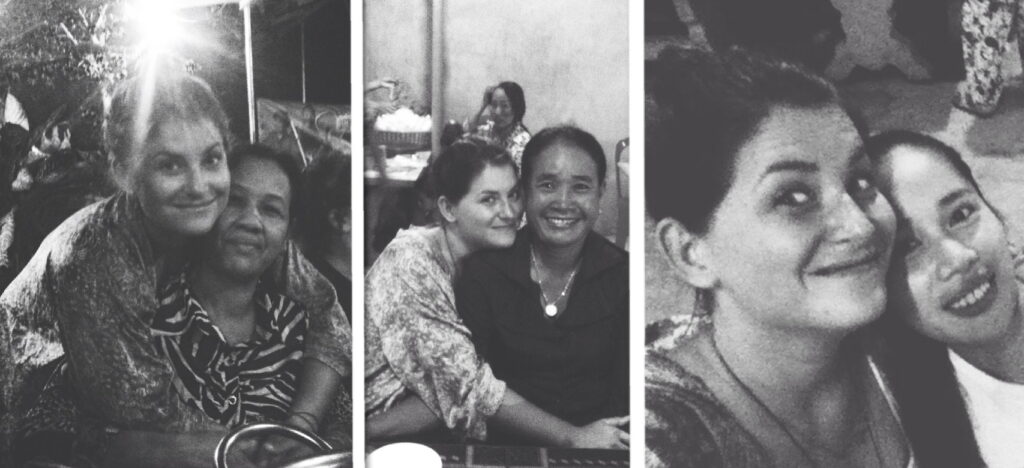
I spent several months working in the field in Cambodia as a midwife for an NGO. It was one of the most challenging periods of my life, as a woman, as a midwife, and as a human being. At the beginning, I didn’t know what I was there for. Everything felt confused. I didn’t know where to start. When I feel overwhelmed like that, my instinct is usually to step back, to change course, to avoid the challenge altogether. But this time, I recognised it was time to jump in and work something out. People were believing in me. They were asking for help, love and kindness. And I needed to grow, both as a woman and as a midwife.
So I stayed.
Growing as a midwife
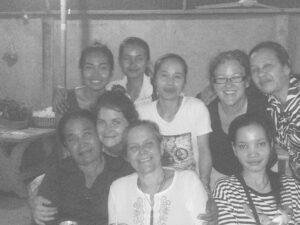
I started working at Rumpea Health Centre, and after a little while we moved to Preh Kebas District, where I met the people who would become my colleagues and, in many ways, my life companions.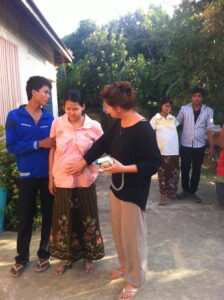
They had never met a baran, a western person, before. I had never met a Khmer person before. We took time to get to know each other, to learn to trust each other. At first, they seemed to hear what we were doing but not really listen
or understand. Then, slowly, they started asking questions. And everything got better, little by little, as we lea
rned to work together, share our passion, and show each other respect.
Meanwhile, I was trying to encourage the women I cared for to follow their instincts, but to do that, I first had to learn how to follow my own. And that was tough.
Birth in the health centre was on a bed in lithotomy position with an routine episiotomy.
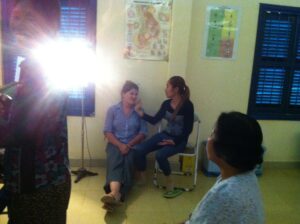 The district health had us to help change this culture, because of the episiotomy and the poor hygiene facilities, they would give antibiotic as prevention to everyone. This practice, long term is not sustainable.
I was used to work in a country where hospitals, doctors, medications and medical supplies are right there, you know you can always rely on something or someone else if things go wrong. You are more likely to act from fear than from trust, to make decisions just to be safe, and still somehow, most of the time, everything will be all right.
Here, it was quite different.
We were in a health centre, but the setting felt more like being at home. We had some birth instruments, a fetal doppler, and oxytocin. That was all. The hospital was more than two hours away, on a very bumpy road, in a very uncomfortable ambulance.
So I had to fall back on what I actually had: my knowledge and my instinct. I started listening, observing, and feeling, with every sense I had.
And I had to face my fear.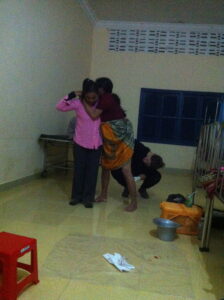
I couldn’t transfer a woman simply because I was unsure, simply because fear told me to. She would have to pay the transport, the hospital fees, the birth costs. I needed to be absolutely certain that transfer was the right choice for her, not a way of managing my own anxiety. There was no room for fear-based decisions here. There was no room for my fear at all.
Learning again to be a midwife
I learned to not disturb the birth process. I learned that the less you do, the better.
I learned to observe carefully, to understand every sign, seen and unseen, that tells you whether something is going wrong or whether a woman simply needs you to step back and give her space.
I found this genuinely hard. I love taking care of women in labour. I love to massage, use my hands, to support. But sometimes women don’t need any of that. Sometimes they are doing it brilliantly by themselves, and all you have to do is be there, holding the space.
That’s all. And that is hard.
You have to read every signal. You may spend time gently encouraging a woman to change positions in labour, and then she chooses to lie down with her legs up. You feel it isn’t ideal, but it is what she has chosen.
Then something changed
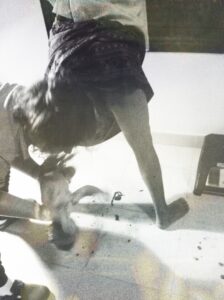
After a few months, women began to trust us, and me. And I began to trust myself. Suddenly, births were happening in squatting or standing positions without me having to suggest anything. A woman would follow her instinct without any guidance, I think because she felt safe enough to. I would feel genuinely proud and surprised: not because of what I had done, but because of what I had learned to stop doing. That is when I understood: Birth is about letting go. Whether you are a woman, a midwife, or anyone in the birth space.
If you, as a midwife, a birthkeeper, can let go gently of your ideas about how birth should look, the woman in front of you will be free to express herself in all the ways she needs to. And she will bring her baby into the world in her own way.
Babies decide how they come to this earth. What you can do is make sure the woman trusts herself, and make sure you trust that too.
As a midwife, your job is also to protect a mother from your own fears. And that is the hardest part of our work.
I always encourage a mother to feel the power of the women who have given birth before her, since the beginning of time and as a midwife, I can feel that too. The support of every birth keeper, midwives, wise women, who has ever lived and supported this sacred work. So, I’m never alone in that room.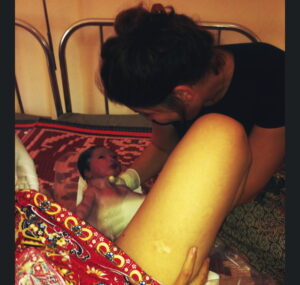
Birth is a sacred space
Birth is ever so sacred.
This is timeless, spaceless moment, where you feel yourself in connection with the full power of birth. You can feel the women of all time giving birth. You can feel the universe’s explosion of life. The edge between birth and death is as thin as a soap bubble.
You are in the past, the present, and the future, all at once. Because the blueprint, the emotional and bodily memories of each human being, are passed on for seven generations.
In those moments, I think of myself as the High Priestess in the tarot: the one who sits at the gateway with open arms and an open heart, at the doorway between life and death.
As a midwife, that is who I am, the one who holds that threshold. Who stops whatever is not needed from entering. Who lets the light and the unconditional love through.
It can be the easiest or the hardest work in the world. It depends on how ready you are to let each story unfold in its own way.
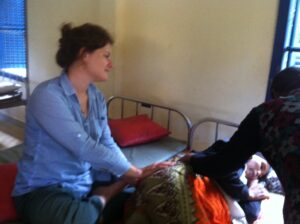 I am always working on that. I will keep working on it for the rest of my life.
I am so grateful that the women of Cambodia helped me begin walking this path. They gave me something no training programme ever could: the experience of trusting and respecting birth completely,
That is what I bring to every birth I attend now.
If you would like to know more about the kind of care I offer at Rise Midwives, check my page or send me a message. I would love to hear from you.
Women’s Health Cambodia staff: Omh Nai, Denise Love, Ramya, Maryla, Botew, Srei, Sim, mr. Set, mr. Tunn, Jim.
And thank you, lovely midwives from all over the world, thanks for your love, support, knowledge, thanks for sharing a little of your life with me: Sylvie Robert and Trish Long, Jenny Blyth, Sarah Taylor.
Thanks to all my friends, supporters, and my very big family, thanks for cheering me, supporting me, and funding me.
Thanks to my family who encourage me to fly high every day, you are my roots, I can feel your love and energy everywhere in the world, even when we are far away.